CREATIVE WRITING AS AN IMPORTANT TOOL IN SECOND LANGUAGE ACQUISITION AND PRACTICE
Журнал: Научный журнал «Студенческий форум» выпуск №41(350)
Рубрика: Педагогика


Научный журнал «Студенческий форум» выпуск №41(350)
CREATIVE WRITING AS AN IMPORTANT TOOL IN SECOND LANGUAGE ACQUISITION AND PRACTICE
1. Introduction
Second language acquisition (SLA) has traditionally emphasized the development of grammatical accuracy, vocabulary knowledge, and communicative competence. However, contemporary research suggests that learners benefit greatly from creative, student-centered approaches that promote expression, imagination, and personal involvement in language use. One of the most effective yet underexplored methods in SLA is creative writing.
According to Smith (2013), creative writing encourages students to use language in meaningful, emotionally engaging ways, which increases motivation and strengthens language retention. Morgan (1994) argues that creative writing supports learner autonomy and helps students view language not only as a system of rules but also as a medium for expressing identity and culture. In addition, Lutzker (2015) highlights that creative writing tasks—such as short stories, poems, or dialogue scripts—allow learners to experiment with linguistic choices and develop fluency in a low-pressure environment.
Despite this, many language classrooms continue to prioritize analytical or mechanical writing tasks. As Babaee (2015) notes in his interview with Alan Maley, teachers often underestimate creative writing because they assume it is too advanced for L2 learners or hard to assess. This article challenges that assumption and aims to demonstrate that creative writing is not only accessible but also highly beneficial for language learners.
The following sections explore existing literature on creative writing in SLA, theoretical perspectives supporting this approach, and the methodology used to analyze students’ perceptions and experiences.
2. Methodology
The study employed a mixed-method research design, integrating both quantitative and qualitative data to obtain a comprehensive understanding of students’ perceptions. A total of 40 undergraduate EFL students, aged 18 to 23, voluntarily participated in the research. All participants were enrolled in an academic English course at the time of data collection.
The primary research instruments included an online questionnaire created via Google Forms, which consisted of both closed-ended items (Likert-scale and multiple-choice questions) and open-ended prompts. These instruments were designed to elicit information about students’ motivation, perceived language development, and the challenges they encountered during the learning process. Additional items were incorporated to explore learners’ attitudes toward creative writing and their self-evaluation of progress.
The study followed a two-step procedure. First, students performed a series of creative writing tasks, which required them to apply the target language in imaginative and reflective ways. Following task completion, participants were asked to fill out the online survey, allowing them to reflect on their learning experience immediately after the activity. This sequencing helped ensure that students’ perceptions were fresh and accurately represented. All responses were collected anonymously to encourage honesty and reduce response bias.
To enrich the analysis, the qualitative comments were examined thematically, while quantitative data from the closed-ended questions were summarized descriptively. Together, these methods provided a detailed and multi-layered view of students’ learning experiences.
3. Results
The data gathered from the questionnaire and open-ended responses provide a comprehensive picture of how students perceived creative writing as part of their EFL learning experience. The findings are presented in three main categories: language development, motivation and engagement, and challenges encountered during the tasks. Overall, the results show that creative writing had a distinctly positive impact on learners’ linguistic growth and emotional involvement in the learning process.
Language Development
Creative writing proved to be an effective tool for enhancing multiple components of students’ language proficiency. As illustrated in Figure 1, the most notable improvement was associated with fluency in thinking, reported by 75% of participants. Students commented that writing creatively pushed them to “think in English”, form ideas faster, and express more complex meanings. This indicates that creative writing can activate higher-order thinking skills and support the internalization of linguistic structures.
Regarding lexical development, 70% of students emphasized that creative tasks exposed them to new vocabulary and encouraged independent word searching. Several participants mentioned that they enjoyed “experimenting with new words”, which suggests that creative contexts make vocabulary learning more meaningful and memorable.
Additionally, 65% of the respondents stated that their grammar awareness improved. Unlike traditional grammar exercises, creative writing required them to apply grammar organically, which made them more aware of tense shifts, clause structures, and stylistic correctness. Some students wrote that they “paid more attention to accuracy because the story had to make sense”, showing how narrative coherence naturally encourages grammatical precision.
Taken together, these results demonstrate that creative writing supports both form-focused and meaning-focused aspects of language acquisition.
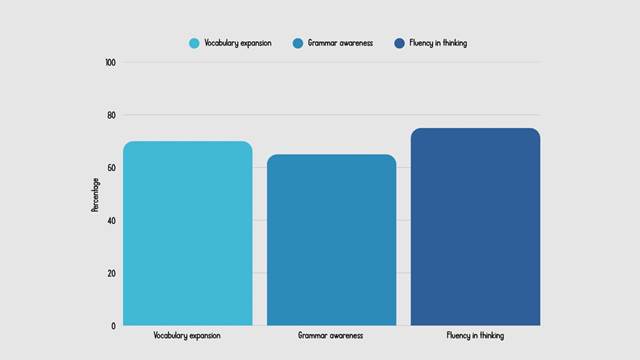
Figure 1. Motivation and Engagement
Students’ responses indicated a high level of motivation associated with creative writing activities. Many described the tasks as “fun”, “relaxing”, and “less stressful than typical essays”. This aligns with existing literature suggesting that creative tasks help lower affective barriers and encourage free expression.
Moreover, several participants highlighted the emotional appeal of creative writing. For some, writing stories or reflective pieces created a personal connection to the language, making learning feel relevant and engaging. A few students pointed out that they felt “more confident” and “more connected to English” when writing about topics that mattered to them.
Another important aspect was autonomy. Students appreciated the freedom to choose themes, characters, or message, which contributed to a sense of ownership over the learning process. This autonomy appears to have strengthened intrinsic motivation, which is crucial for sustained language development.
Challenges Faced by Students
Although most participants reacted positively, a subset of students (20%) reported several challenges while completing the creative writing tasks. These challenges generally fell into predictable categories:
• Idea generation difficulties: Some students struggled to start or to find an appropriate storyline.
• Emotional expression barriers: A few mentioned difficulty conveying feelings accurately in English, which limited the depth of their writing.
• Vocabulary limitations: Certain learners felt they lacked expressive vocabulary needed for more detailed or poetic descriptions.
• Fear of making mistakes: This concern initially inhibited some students from taking creative risks or trying unfamiliar structures.
However, the majority of respondents noted that these difficulties tended to decrease with practice. Several wrote that the tasks became “easier and more enjoyable” over time. This suggests that initial resistance may stem from unfamiliarity with the format rather than from the task itself.

Figure 2. 4. Discussion
The questionnaire results show that most students view creative writing as beneficial for language development. High percentages in vocabulary (70%), grammar awareness (65%), and fluency (75%) suggest that creative tasks help learners use English more meaningfully. These findings support earlier research indicating that creative writing increases motivation and reduces anxiety.
Although 20% of students reported challenges—such as lack of ideas or difficulty expressing emotions—these issues were minor and often decreased with practice. Overall, the results confirm that creative writing is effective for most EFL learners but may require some scaffolding for beginners.
5. Conclusion
This study shows that creative writing positively supports second language acquisition. Students reported improved vocabulary, grammar awareness, and fluency, along with higher motivation. While a small number faced difficulties, most overcame them with guidance. Therefore, creative writing should be used more widely in EFL classrooms as an engaging and meaningful learning tool.
