AUTOMATION OF FILLING LINES IN FOOD PRODUCTION INDUSTRY
Журнал: Научный журнал «Студенческий форум» выпуск №41(350)
Рубрика: Технические науки


Научный журнал «Студенческий форум» выпуск №41(350)
AUTOMATION OF FILLING LINES IN FOOD PRODUCTION INDUSTRY
In modern food production, one of the key areas of focus is the automation of technological processes, which enables increased production efficiency, ensures consistent product quality, and reduces labor costs [1]. Particular importance is attached to the automation of beverage filling lines, as this stage is one of the most critical and labor-intensive. The quality and speed of filling directly influence the final product, including its appearance, hygienic parameters, and shelf life [2].
A beverage filling line encompasses numerous technological operations: container preparation, filling, capping, and labeling. Manual execution of these operations not only increases the risk of errors and defects but also significantly decreases the enterprise’s productivity [2]. Therefore, the implementation of automated filling systems becomes essential [3].
Modern automation technologies involve the use of various control and monitoring systems, such as programmable logic controllers (PLCs), sensors, visualization systems, and automatic regulation units [4]. This allows achieving high precision and reliability in equipment operation. An important objective is also to reduce maintenance and repair costs, which is facilitated by the use of advanced diagnostic and preventative methods [5].
The object of study in this work is the beverage filling line at a food manufacturing facility, while the subject is the methods and means of automating this technological process.
The goal of this paper is to explore automated methods of beverage filling in food production facilities.
The relevance of this topic is driven by the need to enhance the competitiveness of food industry enterprises, comply with strict safety and quality standards, and reduce costs while maintaining a high level of efficiency [3].
Liquid product filling is a process widely used in the food industry and chemical sector. Several approaches exist for performing this operation. Below, we examine in detail the main liquid filling methods that are broadly applied in modern manufacturing plants.
Level-based volume dosing involves using specialized sensors to detect a pre-set fill level within the container. The liquid is dispensed until the specified level is reached. This approach is particularly suitable for filling small containers such as bottles or cans. The design of systems implementing this method is relatively simple, which contributes to low manufacturing and operational costs [6].
Advantages: simple implementation, low cost, relatively high dosing accuracy.
Disadvantages: limited to liquid products only, and less adaptable to variations in product characteristics.
An example of a filling line design utilizing a level sensor is shown in figure 1:
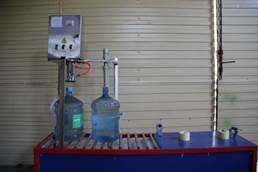
Figure 1. Example of a beverage filling system design utilizing a level sensor
Time-based dosing method. This method is based on the principle of dispensing an exact volume of liquid within a predetermined time frame. The dosage volume is calculated based on the flow rate of the liquid and the duration of the filling process. It is important to note that this approach is suitable when the physico-chemical properties of the liquid remain constant under changing environmental conditions (temperature, pressure) [6].
Advantages: cost-effectiveness, high throughput, quick equipment setup.
Disadvantages: requires precise calibration of the equipment for specific production conditions.
Figure 2 illustrates a liquid filling line utilizing the time-based dosing method. Control is managed via a monitor, which is visible on the right side of the image.
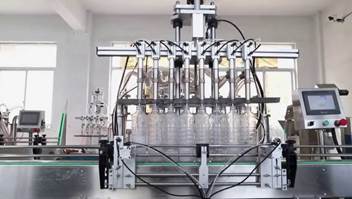
Figure 2. Filling line with time-based dosing method
The most advanced and precise filling method is implemented using equipment equipped with a dedicated device — a flowmeter. This technology measures the exact volume of liquid passing through it, accounting for liquid density and ambient temperature. All data is instantaneously processed by the control system, enabling maintaining a high level of filling accuracy even under significant environmental fluctuations [4].
Advantages: highest dosing precision, independence from external influences, capability to fill any liquid volume.
Disadvantages: high acquisition and maintenance costs, complexity of system installation and calibration.
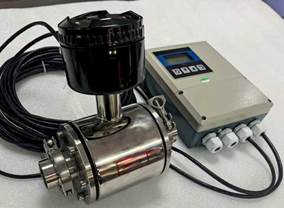
Figure 3. Flowmeter
