FORMATION OF COMPETENCIES OF FUTURE PRESCHOOL TEACHERS BASED ON ARTIFICIAL INTELLIGENCE TECHNOLOGY
Конференция: XCVII Международная научно-практическая конференция «Научный форум: инновационная наука»
Секция: Педагогика


XCVII Международная научно-практическая конференция «Научный форум: инновационная наука»

FORMATION OF COMPETENCIES OF FUTURE PRESCHOOL TEACHERS BASED ON ARTIFICIAL INTELLIGENCE TECHNOLOGY
Abstract. This study investigates the process of forming professional competencies of future preschool teachers through the integration of artificial intelligence (AI) technologies into teacher education. The research emphasizes that AI‑based platforms provide personalized learning pathways, adaptive feedback, and interactive simulations, which significantly enhance digital literacy, creative problem‑solving, and critical thinking skills. Key innovations include the use of intelligent tutoring systems, virtual pedagogical environments, and AI‑driven diagnostic tools that allow students to model professional situations and develop readiness for inclusive preschool education. The findings demonstrate that AI integration fosters professional adaptability, supports curriculum modernization, and contributes to the preparation of teachers capable of addressing the challenges of the digital era. The study concludes that the application of artificial intelligence technologies in preschool teacher training ensures the formation of future‑oriented competencies, strengthens methodological culture, and positions preschool pedagogy as a dynamic and innovative field aligned with international educational trends.
Keywords: Artificial Intelligence in Education, Preschool Teacher Competencies, Digital Literacy, Creative Pedagogy, Inclusive Education.
Introduction. The digital transformation of education has redefined the professional landscape of teacher preparation. Artificial intelligence (AI) is emerging as a key driver of innovation, offering tools that personalize learning, simulate pedagogical processes, and enhance the analytical and creative capacities of future educators. In preschool education, the integration of AI technologies is particularly significant. It enables future teachers to design adaptive learning environments, analyze children’s developmental data, and apply creative pedagogical strategies that respond to individual needs. The formation of competencies through AI‑based training ensures that educators acquire digital literacy, methodological flexibility, and ethical awareness—qualities essential for guiding children in the 21st century. This research situates AI within the framework of pedagogical design, emphasizing its role in developing professional readiness and innovative thinking. The study contributes to the modernization of preschool teacher education by aligning national priorities with global trends in educational technology. To illustrate the idea, imagine a digital classroom where future preschool teachers interact with AI‑powered tools:
- Virtual assistants guide lesson planning.
- Simulated child behavior models help analyze pedagogical responses.
- Creative AI platforms generate adaptive learning materials.
Such environments visualize the transformation of teacher education into a dynamic, technology‑enhanced process.
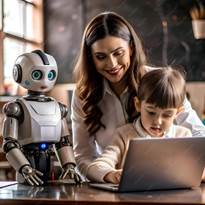

Figure 1.
The formation of professional competencies in future preschool teachers through artificial intelligence technologies has become a central topic in contemporary educational research. The literature reveals a growing consensus that AI integration transforms teacher education by enhancing personalization, interactivity, and data‑driven decision‑making.
Table 1.
|
Research Area |
Key Focus |
Main Findings |
|
Global Research Context |
AI in Teacher Education |
International studies (Holmes et al., 2022; Luckin, 2023) emphasize that AI supports adaptive learning environments, enabling future teachers to receive individualized feedback and simulate pedagogical scenarios. These technologies enhance digital literacy, reflective thinking, and professional autonomy. |
|
Digital Pedagogy and Competence Formation |
TPACK Framework and UNESCO ICT Standards |
Research by Mishra & Koehler and UNESCO highlights that digital competence extends beyond technical skills to include ethical, creative, and communicative dimensions essential for preschool educators. |
|
Kazakhstani and Regional Studies |
AI and Educational Modernization in Kazakhstan |
Kazakhstani scholars (Kussainov, 2024; Zhanturina, 2025) explore AI integration in teacher preparation programs, focusing on national priorities for digital transformation and inclusive education. Their works stress alignment between technological innovation and cultural pedagogical values. |
|
Preschool Pedagogy and Innovation |
Creative Pedagogical Design |
Regional research emphasizes the need for creative pedagogical design using AI based tools for modeling child development, assessing learning outcomes, and supporting differentiated instruction. |
|
Constructivist Learning Theory |
AI Enhanced Learning Environments |
AI environments align with constructivist principles, allowing learners to build knowledge through exploration and reflection. |
|
Competency Based Education |
Outcome Oriented Learning |
The competency approach emphasizes measurable outcomes—knowledge, skills, and attitudes—that AI systems can track and support through analytics and adaptive feedback. |
|
Pedagogical Design Frameworks |
Systematic Competency Development |
Integrating AI into pedagogical design ensures systematic development of professional competencies, combining technological fluency with humanistic values. |
AI‑based tools such as intelligent tutoring systems, adaptive simulations, and diagnostic platforms create interactive learning environments that foster digital literacy and creative problem‑solving. These environments allow teacher candidates to experiment with diverse pedagogical strategies, analyze child development data, and design inclusive learning scenarios. The integration of AI thus modernizes preschool pedagogy by bridging theory with practice. The study demonstrates that AI integration strengthens competency‑based education. Future preschool teachers acquire not only technical skills but also reflective, ethical, and communicative competencies. By engaging with AI‑driven platforms, they develop adaptability to diverse classroom contexts and readiness to address challenges of the digital era. This aligns with global frameworks such as UNESCO’s ICT Competency Standards for Teachers. In the Kazakhstani context, the integration of AI into preschool teacher training supports national priorities for educational modernization. It ensures that teacher preparation programs are aligned with both local cultural values and international educational trends. The discussion emphasizes that AI should not replace human pedagogy but rather serve as a catalyst for innovation, inclusivity, and ecological awareness.
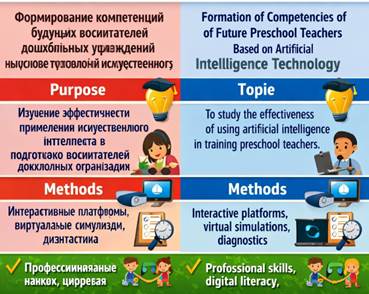
Figure 2.
The conducted research confirms that the integration of artificial intelligence technologies into preschool teacher education fundamentally transforms the process of professional competency formation. AI serves not merely as a technological instrument but as a pedagogical catalyst that enhances personalization, creativity, and inclusivity in teacher preparation.
Competency Formation: Future preschool teachers develop digital literacy, analytical thinking, and creative pedagogical skills through AI‑based learning environments.
Pedagogical Innovation: Intelligent tutoring systems and virtual simulations enable modeling of real teaching scenarios, bridging theory and practice.
Inclusive and Ecological Orientation: AI supports differentiated instruction and fosters ecological awareness, aligning with sustainable education goals.
The study demonstrates that AI integration contributes to the modernization of preschool pedagogy, aligning national educational priorities with global trends. It promotes the development of educators capable of guiding children in the digital and ecological age—teachers who combine technological competence with humanistic values. In conclusion, the formation of competencies of future preschool teachers based on artificial intelligence technology ensures the creation of a new generation of educators who are innovative, reflective, and ethically responsible. This approach strengthens the methodological culture of teacher education and positions preschool pedagogy as a dynamic, forward‑looking field within the global educational landscape.
