DEVELOPMENT OF A TECHNOLOGICAL PROCESS FOR THE SYNTHESIS OF A CDCL2–HMTA COMPLEX AND ITS APPLICATION IN COALESCER FILTER CLEANING
Конференция: XC Международная научно-практическая конференция «Научный форум: медицина, биология и химия»
Секция: Нефтехимия


XC Международная научно-практическая конференция «Научный форум: медицина, биология и химия»
DEVELOPMENT OF A TECHNOLOGICAL PROCESS FOR THE SYNTHESIS OF A CDCL2–HMTA COMPLEX AND ITS APPLICATION IN COALESCER FILTER CLEANING
Abstract. The accumulation of inorganic deposits and corrosion products on coalescer filters significantly reduces filtration efficiency and increases maintenance costs in natural gas processing facilities. This study aimed to develop a technological process for the synthesis of a CdCl₂–HMTA coordination complex and evaluate its application as a chemical cleaning agent for contaminated coalescer filters. The coordination complex was synthesized under optimized conditions using a CdCl₂:HMTA molar ratio of 1:2.3 in a 20% (v/v) ethanol solution at 20–35 °C, pH 5.5–6.5, and a reaction time of 60 min. Based on the optimized synthesis parameters, a technological process flow diagram was developed, including solution preparation, controlled reagent addition, crystallization, filtration, and drying. Furthermore, a four-stage technological process for coalescer filter cleaning was proposed using 3.5 wt.% hydrochloric acid and 1 wt.% CdCl₂–HMTA complex solution under ultrasonic treatment. Each cleaning stage was performed for 30 min at 20–25 °C, ensuring efficient removal of deposits while preserving the filter structure. The developed technological schemes provide a practical basis for scaling up both the synthesis of the CdCl₂–HMTA complex and the regeneration of contaminated coalescer filters. The proposed technology has considerable potential for reducing maintenance costs, extending filter service life, and improving the operational reliability of industrial gas processing systems.
Keywords: CdCl₂–HMTA complex; coalescer filter; chemical cleaning; technological process; coordination complex; natural gas processing.
Introduction
Natural gas processing plants play a crucial role in supplying clean energy to industrial and domestic consumers [1]. During gas purification and dehydration processes, coalescer filters are extensively employed to remove entrained liquid droplets, aerosols, and solid contaminants from process streams [2]. Continuous operation under harsh industrial conditions leads to the gradual accumulation of corrosion products, inorganic salts, sulfur-containing compounds, hydrocarbons, and other deposits on the filter media [3]. The formation of these deposits significantly reduces filtration efficiency, increases pressure drop, shortens filter service life, and adversely affects the operational reliability of gas processing facilities [4].
Conventional cleaning methods for contaminated coalescer filters mainly involve mechanical washing, acid treatment, or complete replacement of filter elements [5]. Although these methods can partially restore filter performance, they are often associated with high operational costs, excessive chemical consumption, damage to filter materials, and increased industrial waste generation [6]. Consequently, the development of efficient chemical cleaning agents capable of selectively removing inorganic deposits while preserving the structural integrity of coalescer filters has become an important research objective [7].
Metal-organic coordination complexes have recently attracted considerable attention due to their unique physicochemical properties, including high chemical stability, controlled coordination behavior, and enhanced interaction with metal oxide deposits [8-9]. Among them, cadmium chloride (CdCl₂) readily forms stable coordination compounds with hexamethylenetetramine (HMTA) [10], producing complexes capable of interacting with corrosion products and inorganic contaminants [11]. Such complexes offer promising opportunities for improving the efficiency of chemical cleaning processes in industrial filtration systems [12].
Despite numerous studies on corrosion removal and chemical cleaning technologies, limited attention has been devoted to the synthesis of CdCl₂–HMTA complexes and their application as cleaning agents for industrial coalescer filters [13]. Furthermore, the technological aspects of complex synthesis, including reagent ratio optimization, synthesis conditions, process flow design, and industrial implementation, have not been comprehensively investigated [14].
Therefore, the objective of the present study was to develop a technological process for the synthesis of a CdCl₂–HMTA complex and to evaluate its application in the chemical cleaning of contaminated coalescer filters used in natural gas processing plants. The synthesis conditions of the coordination complex were optimized, a technological process scheme was proposed, and the cleaning performance of the synthesized complex was assessed in terms of deposit removal efficiency and restoration of filter operating characteristics. The obtained results provide a practical basis for extending coalescer filter service life while reducing maintenance costs and improving the operational efficiency of gas processing facilities.
Materials and Methods
Materials
Cadmium chloride monohydrate (CdCl₂·H₂O, analytical grade) and hexamethylenetetramine (HMTA, analytical grade) were used as the precursor materials for the synthesis of the coordination complex. Ethanol and distilled water were employed as the reaction medium. All reagents were used without further purification.
Contaminated coalescer filter samples were collected from the gas purification unit of a natural gas processing plant. Before chemical treatment, the filters were visually inspected and characterized to evaluate the extent of inorganic deposit accumulation.
Synthesis of the CdCl₂–HMTA Complex
The CdCl2–HMTA coordination complex was synthesized by dissolving cadmium chloride monohydrate in a 20% (v/v) ethanol–water solution under continuous stirring. Hexamethylenetetramine solution was then added dropwise to the cadmium chloride solution while maintaining constant stirring. The molar ratio of CdCl2 to HMTA was fixed at 1:2.3, which had previously been identified as the optimum composition.
The reaction mixture was stirred at 350–500 rpm for 60 min at room temperature while maintaining the solution pH between 5.5 and 6.5. After completion of the reaction, the obtained complex was allowed to crystallize, separated by filtration, washed with distilled water, and dried at ambient conditions.
Development of the Technological Process Scheme
Based on the optimized laboratory synthesis conditions, a technological process scheme for CdCl₂–HMTA complex production was developed. The technological flow included reagent storage, solution preparation, controlled mixing, complex formation, crystallization, filtration, washing, drying, and product collection. The proposed process was designed to ensure continuous operation, stable product quality, and easy industrial implementation.
Application of the CdCl₂–HMTA Complex in Coalescer Filter Cleaning
The synthesized CdCl₂–HMTA complex was employed as a chemical cleaning agent for contaminated coalescer filters. The cleaning solution consisted of 3.5 wt.% hydrochloric acid containing 1 wt.% CdCl₂–HMTA complex. The contaminated filters were immersed in the cleaning solution and treated under ultrasonic agitation for 30 min.
Following chemical cleaning, the filters were thoroughly rinsed with distilled water to remove residual chemicals and dried at room temperature. The cleaning efficiency was evaluated by comparing the amount of deposits before and after treatment as well as by visual examination of the cleaned filter surface.
Evaluation of Cleaning Efficiency
The cleaning efficiency of the developed chemical treatment was determined from the percentage removal of deposits using the following equation:
 (1)
(1)
where:
- η is the cleaning efficiency (%);
- m₀ is the initial mass of deposits before cleaning (g);
- m_f is the residual deposit mass after chemical cleaning (g).
All experiments were carried out in triplicate, and the reported results represent the average values obtained from three independent measurements.
Results and Discussion
The technological process for the synthesis of the CdCl2–HMTA coordination complex was developed based on the optimized laboratory conditions to ensure stable product quality and facilitate industrial implementation. The proposed process integrates solution preparation, controlled reagent dosing, complex formation, crystallization, solid–liquid separation, and drying into a continuous technological sequence. Each processing stage was designed to maximize the synthesis efficiency while maintaining the physicochemical stability of the coordination complex.
The technological process flow diagram developed for the synthesis of the CdCl2–HMTA complex is presented in Figure 1. The proposed scheme provides the basis for scaling up the laboratory synthesis to pilot and industrial production and enables the production of a coordination complex suitable for application as an effective chemical cleaning agent for contaminated coalescer filters.
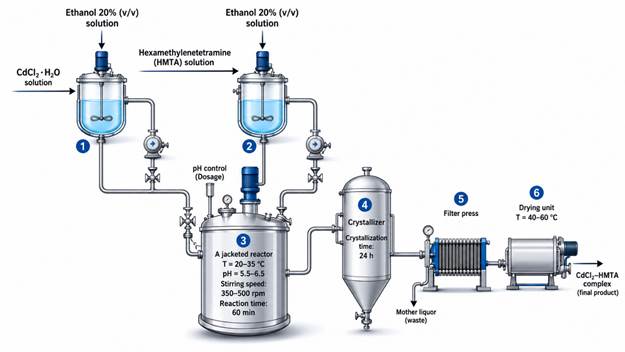
Figure 1. Technological scheme for the synthesis of the CdCl2-HMTA coordination complex
The technological process developed for the synthesis of the CdCl₂–HMTA coordination complex is illustrated in Figure 1. The process begins with the preparation of two precursor solutions. In the first stage, cadmium chloride monohydrate (CdCl₂·H₂O) is dissolved in a 20% ethanol solution in reactor (1) under continuous agitation to obtain a homogeneous solution. Simultaneously, hexamethylenetetramine (HMTA) is dissolved in a separate vessel (2) using the same solvent system to ensure complete dissolution before the synthesis reaction.
The prepared precursor solutions are then continuously transferred to the agitated reactor (3), where the HMTA solution is introduced through a dosing system to provide controlled reagent addition. The synthesis is carried out at 20-35 °C, pH 5.5-6.5, with a stirring speed of 350-500 rpm for 60 min. Maintaining these operating parameters ensures efficient coordination between Cd²⁺ ions and HMTA molecules, promoting the formation of a stable coordination complex while minimizing undesirable side reactions.
Following complex formation, the reaction mixture is transferred to the crystallizer (4), where it is maintained for 24 h to allow complete crystal growth. The crystallized product is subsequently separated from the mother liquor using a filter press (5), and the obtained wet solid is dried at 40-60 °C in the dryer (6) to produce the final CdCl2–HMTA coordination complex. The proposed technological scheme integrates solution preparation, controlled synthesis, crystallization, solid–liquid separation, and drying into a continuous production process, providing a practical basis for scaling up laboratory synthesis to pilot and industrial applications.
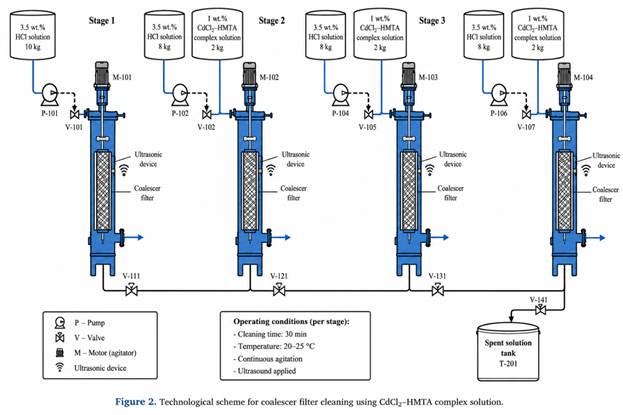
Figure 2. Technological scheme for chemical cleaning of coalescer filters using the CdCl₂–HMTA complex solution
The multistage technological process developed for coalescer filter cleaning using the CdCl₂–HMTA complex solution is presented in Figure 2. The proposed process consists of four consecutive cleaning stages designed to maximize deposit removal while minimizing damage to the filter medium. In the first stage, the contaminated coalescer filter is treated with 10 kg of 3.5 wt.% hydrochloric acid solution, which removes loosely bound inorganic deposits and prepares the filter surface for subsequent chemical treatment. The cleaning solution is circulated through the filter using a centrifugal pump while ultrasonic irradiation is simultaneously applied to enhance mass transfer and accelerate contaminant removal.
During the second, third, and fourth cleaning stages, the filter is treated with a mixed solution consisting of 8 kg of 3.5 wt.% hydrochloric acid and 2 kg of 1 wt.% CdCl₂–HMTA complex solution. The cleaning solution is continuously circulated through the filter element under ultrasonic agitation, promoting efficient interaction between the coordination complex and firmly adhered corrosion products. Each cleaning stage is performed for 30 min at a temperature of 20–25 °C under continuous mixing, ensuring uniform chemical distribution throughout the filter structure and improving the dissolution of residual deposits.
After completion of the fourth stage, the spent cleaning solution is discharged into the collection tank for subsequent treatment or disposal. The proposed technological scheme integrates chemical cleaning, ultrasonic activation, controlled reagent circulation, and multistage processing into a single operational system. Such a configuration provides effective regeneration of contaminated coalescer filters while reducing chemical consumption, extending filter service life, and improving the operational reliability of natural gas processing facilities.
Conclusion
A technological process for the synthesis of the CdCl₂–HMTA coordination complex was successfully developed under optimized reaction conditions, including a CdCl₂:HMTA molar ratio of 1:2.3, 20% (v/v) ethanol solution, 20–35 °C, pH 5.5–6.5, and a reaction time of 60 min. Based on these parameters, a complete technological process flow diagram incorporating solution preparation, complex synthesis, crystallization, filtration, and drying was proposed for potential industrial implementation.
Furthermore, a multistage technological process for the regeneration of contaminated coalescer filters was developed using a cleaning solution composed of 3.5 wt.% hydrochloric acid and 1 wt.% CdCl₂–HMTA complex under ultrasonic treatment. The proposed cleaning technology consists of four consecutive stages, providing efficient contact between the cleaning solution and the contaminated filter surface while maintaining stable operating conditions.
