PERSONAL CHARACTERISTICS OF PRESCHOOLERS WITH HARMONIOUS AND DISHARMONIOUS TYPES OF CHILD-PARENT RELATIONS
Журнал: Научный журнал «Студенческий форум» выпуск №10(361)
Рубрика: Психология


Научный журнал «Студенческий форум» выпуск №10(361)
PERSONAL CHARACTERISTICS OF PRESCHOOLERS WITH HARMONIOUS AND DISHARMONIOUS TYPES OF CHILD-PARENT RELATIONS
Abstract. The article examines the personal characteristics of preschoolers with harmonious and disharmonious types of child-parent relations. The study of the relationship between the personal characteristics of preschoolers and the characteristics of the types of child-parent relationships is an important area of research in developmental psychology and pedagogy. Understanding these features makes it possible to optimize the processes of socialization and adaptation of children, as well as to develop effective strategies for psychological and pedagogical correction. The types of child-parent relationships have a significant impact on the personal development of preschoolers. The results of empirical research aimed at studying the personal characteristics of preschoolers with harmonious and disharmonious types of child-parent relations are presented and analyzed.
Keywords: child-parent relations, harmonious relations, disharmonious relations, socialization, adaptation.
Family is the first stage of development in a person's life. She directs the consciousness, will, and feelings of children from an early age.
Personality development in preschool age is inextricably linked with self- image awareness. Step by step, the child gets an idea of a person in general and of himself as one of the people. This awareness is facilitated by the preschooler's involvement in various activities and communication. Personality development involves the development of cognitive processes and moral qualities, the formation of a worldview and self-awareness, the development of independence in activities and social activity. This is not a complete list of those features that characterize a person's personality, but they are the main driving forces behind the formation of a child's personality [Anan'ev, B. G. 2010: 263].
Personality traits of preschoolers are formed under the influence of many factors, among which the key role is played by child-parent relations. The harmonious and disharmonious types of these relationships have a significant impact on the development of the child's emotional, social and cognitive spheres. Children raised in a harmonious parent-child relationship characterized by empathy, support, and consistency demonstrate higher self-esteem, emotional stability, and the ability to adequately adapt socially. In contrast, disharmonious child-parent relationships, including rejection, overprotection, or inconsistency, can lead to anxiety, aggression, and difficulties in establishing healthy interpersonal relationships in children.
The special importance of the relationship between children and their parents has long attracted the attention of many psychologists from various fields and types of schools. Issues related to the problem of child-parent relations have been considered by scientists throughout the development of psychological science and practice. In Russian psychology, scientists L.I. Bozhovich, L.S. Vygotsky, I.V. Dubrovina, A.N. Leontiev, M.I. Lisina, V.S. Mukhina, G.T. Khomentauskas, D.B. Elkonin and many others were engaged in research in this field.
Family relationships in which a child is involved in one way or another are child-parent relationships. Scientific psychology and pedagogy are very far behind practice, despite the fact that the importance of these relationships attracts the attention of a large number of schools and areas. As has been emphasized in Russian theoretical approaches, the relationship with an adult parent plays a crucial role in the development of a child's personality. But it should be noted that these relations are not the subject of research, neither in an active nor in a cultural and historical approach (A.N. Leontiev, L.S. Vygotsky) [Leont'ev, A.N. 2019: 426]. Clinical psychologists have accumulated the greatest experience of working with child-parent relations.
Representing a complex psychological mechanism, child-parent relationships require constant learning and understanding. They contain elements of parenting, love, mutual understanding, and authority that build invisible but extremely important bonds between parents and children. This dynamic is unique and changeable, so it's important to be able to observe, adapt, and find balance in this complex system of relationships.
Disharmonious types of child-parent relationships, characterized by rejection, overprotection, inconsistency, or conflict, have a destructive effect on the personal development of preschoolers. Children raised in such conditions are prone to developing anxiety, aggressiveness, difficulties in establishing interpersonal relationships, and low self-esteem [Belyaeva 2016: 1-10].
Harmonious child-parent relations, characterized by emotional warmth, consistent discipline and support for the child's autonomy, have a significant impact on the formation of his personality. Children raised in such conditions demonstrate higher self-esteem, self-confidence, and the ability to empathize.
Researchers such as A.Ya. Varga, A.I. Kabanova, A.G. Leaders, T.V. Yakimova and many others emphasize that child-parent relationships reflect not only the individual aspects of each family member's personality, but also a wide range of socio-psychological phenomena that affect their dynamics and development. Learning to understand, respect, and support this unique, bizarre system means developing together and building a strong and harmonious family bond [Karabanova, O.A. 2019: 71–79].
Child-parent relationships are different from other types of interpersonal relationships, they are quite specific. In her writings, she reveals the specifics of child-parent relations, noting that they are characterized by strong emotional significance for both the child and the parent, as well as ambivalence in the parent- child relationship.
The personal characteristics of a parent have an impact on the relationship with the child, which is confirmed by the concept of a "Schizophrenic mother." A woman with such features causes severe anxiety in the baby and seeks to control it, preventing normal development. She demands the same perfection from others as from herself. The husbands of these women are often isolated and allow them to manage everything. As a result, children seek safety by playing in the world that their mother offers them, hiding their negative emotions behind apparent concern [Ryabova, S.N. 2023: 487]
Child-parent relations play a key role in shaping a person's personality and setting a person's life path. The family environment and interaction with parents have a huge impact on the emotional and psychological development of a child. It is important to note that not only the parenting style, but also child-parent relationships, parental attitudes, as well as types and models of family education form the foundations of an individual's future behavior and worldview.
Research shows that children from families with harmonious parent-child relationships have better self-regulation skills, cope better with stress, and demonstrate higher academic performance. Thus, harmonious relationships act as an important factor contributing to the optimal personal development of preschoolers.
The study of the personal characteristics of preschoolers with harmonious and disharmonious types of child-parent relations was conducted on the basis of the municipal autonomous preschool educational institution kindergarten No. 69 "Skazka Child Development Center" in Belgorod. The study involved 25 senior preschoolers and 25 parents.
The purpose of the study was to study the personal characteristics of preschoolers with harmonious and disharmonious types of child-parent relations.
The objectives of the study were as follows:
- Identify the personality traits of preschoolers.
- To study the harmonious and disharmonious types of child-parent relations.
- To identify the personal characteristics of preschoolers with harmonious and disharmonious types of child-parent relations.
- Develop recommendations for parents on improving child-parent relations.
The following set of techniques and methods was used to conduct the study:
- The methodology of "Studying social emotions" by G.A. Uruntayeva and Yu.A. Afonkina. The technique allows us to identify the development of social emotions in children. The method is most relevant for preschool age from 3 to 7 years. Data processing: 3 points – high – for each acceptable response and manifestation of a positive social emotion; 2 points – average – for a socially acceptable response and manifestation of a negative emotion; 1 point – low – the child evades or avoids the answer.
- The "Ladder" technique (V.G. Shchur). Purpose: to study the self-esteem of an older preschool child. Age of use: from 5 years. Procedure: The child is shown a painted ladder with seven steps, and given instructions. A standard set of characteristics is used: "good – bad", "kind – evil", "smart – stupid", "strong – weak", "brave – cowardly", "the most diligent – the most careless". The number of characteristics can be reduced. During the examination, it is necessary to take into account how the child performs the task: he experiences hesitation, thinks about it, and explains his choice. If the child does not give any explanations, he should be asked clarifying questions.: "Why did you put yourself here? Are you always like this?" etc.
- Parental attitude test questionnaire (A.Ya. Varga, V.V. Stolin). The Parental Attitude Test (ORO) is a psychodiagnostic tool aimed at identifying parental attitudes towards children. Parental attitude is understood as a system of diverse feelings towards a child, behavioral stereotypes practiced in communicating with him, the peculiarities of perception and understanding of the child's character and personality, and his actions. The questionnaire consists of 5 scales: "Acceptance-rejection", "Cooperation", "Symbiosis", "Authoritarian hypersocialization", "Little loser".
Statistical data processing was carried out using Spearman's rank correlation coefficient. This statistical indicator allows not only to test the hypothesis of a linear relationship between the features, but also to establish its strength.
To begin with, we analyzed the results of preschoolers using the "Study of social emotions" methodology by G.A. Uruntayeva and Yu.A. Afonkina.
Most preschoolers have an average level of social emotions (Mx=3.4). This indicator reflects the formation of basic skills of empathy, empathy and the ability to regulate emotional states in social situations. This indicates that parents have parenting strategies that promote the moderate development of social and emotional competence.
In addition, preschoolers have a low level of social emotions (Mx=2.5). Low scores may indicate a deficit in emotional responsiveness, difficulties in recognizing and interpreting other people's emotional states, as well as a reduced ability to interact socially.
Fewer preschoolers have a high level of social emotions (Mx=1.8). High scores may indicate that a child has marked abilities for empathy, altruism, and prosocial behavior.
Next, we will analyze the results of the level of self-esteem in preschool age.
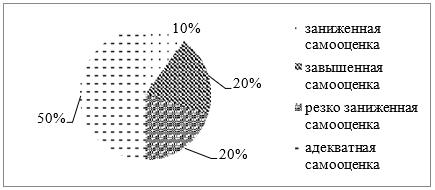
Figure 1. Distribution of preschoolers by self-esteem level
According to Figure 1, we see that the majority of respondents, i.e. 50%, have adequate self-esteem. This indicates that children treat themselves positively. Most of the respondents in our sample know how to evaluate themselves and their activities, treat themselves well, and can even give examples of their strengths.
The figure also shows that 20% of children overestimate their self-esteem. For a preschooler, this is the age norm. In most cases, children cannot justify their answer because they trust the opinion of the adults around them. So, Mom's words: "You are the best" and such things are taken literally by the child.
10% of preschool children have low self-esteem. This indicates that they have some kind of psychological problems. For example, this is often due to the lack of "successful situations" in their lives, which affects their self-confidence. The child does not believe in his abilities, and this can become a serious obstacle to his development. In addition, in our methodology, such children usually choose the 4th step of the ladder, which also indicates their lack of confidence. Maybe they have problems that they can't handle yet. These may be conflicts with parents or a wish that was not realized due to some circumstances.
The study of the type of parental relationship was conducted using a questionnaire by A.Ya. Varga, V.V. Stolin. As a result of the diagnosis, we identified two groups of parents, depending on the type of child-parent relationship.
High scores of adults on the Symbiosis scale (Mx = 6.9) indicate the desire of parents for a close emotional connection with the child, possibly with elements of excessive involvement and limited independence. However, low scores on the "Control" scale (Mx=4.7) indicate insufficient regulation of the child's behavior and a weakening of disciplinary measures.
Normal parental scores on the "Cooperation" scale (Mx=6.3) indicate that parents have the ability to interact constructively with their child based on partnership and consideration of their interests. However, a high level of authoritarianism, manifested in high indicators on the scale of "Infantilization" (Mx=5.9), can offset the positive impact of a cooperative parenting style. Infantilization, which is expressed in high expectations regarding the intellectual abilities of the child and ignoring his age characteristics.
To identify the personal characteristics of preschoolers with harmonious and disharmonious types of child-parent relations, statistical data processing was carried out using Spearman correlation analysis (Table 1).
Table 1.
Coefficients of linear correlations of personality characteristics of preschoolers with harmonious and disharmonious types of child-parent relations
|
Types of child-parent relations |
Personality traits of preschoolers |
Spearman Correlation Coefficient* |
|
Infantilization |
Low self-esteem |
0,512** |
|
Low level of emotional development |
0,501** |
|
|
Control |
Dramatically low self-esteem |
0,429** |
|
Low level of emotional development |
0,359** |
|
|
Symbiosis |
Adequate self-assessment |
0,419** |
|
High level of emotional development |
0,304** |
|
|
Cooperation |
Excessive self-esteem |
0,384** |
|
High level of emotional development |
0,400** |
|
|
Acceptance-rejection |
Adequate self-assessment |
0,394** |
|
High level of emotional development |
0,308** |
A positive correlation was found between the parameter "Infantilization" of parental attitude and low self-esteem in children (p=0.512, p<0.01), as well as a low level of emotional development (p=0.501, p<0.01). These results show the negative impact of rejection and non-acceptance by parents on the formation of a child's self-esteem and emotional sphere.
A similar relationship was found between increased parental "Control" and sharply lowered self-esteem in preschoolers (p=0.429, p<0.01), as well as a low level of their emotional development (p=0.359, p<0.01). Excessive control and limited independence prevent a child from developing a sense of competence and self-confidence.
On the contrary, the type of parental relationship "Symbiosis 2" positively correlates with adequate self-esteem in children (p=0.419, p<0.01) and a high level of emotional development (p=0.304, p<0.01). A similar trend is observed for the types of "Cooperation" (p=0.384, p<0.01 for overestimated self-esteem; p=0.400, p<0.01 for a high level of emotional development) and "Acceptance-rejection" (p=0.394, p<0.01 for adequate self-esteem; p=0.308, p<0.01 for high the level of emotional development).
Thus, the hypothesis of the study is that children raised in families with a harmonious type of relationship (symbiosis, cooperation, acceptance) demonstrate a higher level of emotional development and adequate self-esteem, while children from families with a disharmonious type of relationship (infantilization, control, rejection) tend to have low self-esteem and a low level of emotional development., proved. The family is the first social institution in which a child makes first contact and acquires communication skills. The family has significant rehabilitation potential, which can be used to help a child with developmental problems. However, its use is possible only with an adequate perception of the child's problems by his parents and a well-formed understanding of their role in the child's development. The creation and maintenance of a healthy psychological climate in the family serves as a guarantee of the harmonious development of the child and allows him to fully reveal his potential.
